
The Day We Read My Grandmother’s Will
We all gathered at the lawyer’s office to hear my grandmother’s last will and testament. The room felt unusually quiet, and everyone seemed anxious to discover what she had left behind.
My grandmother had spent her entire life building a home filled with memories. She had also managed to save money carefully over the years, and nobody knew exactly how much she had accumulated.
When the lawyer finally began reading, we listened closely.
Then came the announcement that changed everything.
My grandmother had left the house, her savings, and everything else she owned to me.
For a moment, I couldn’t speak. I loved my grandmother dearly, but I had never expected to inherit her entire estate.
My aunt, however, reacted very differently.
My Aunt Accused Me of Stealing
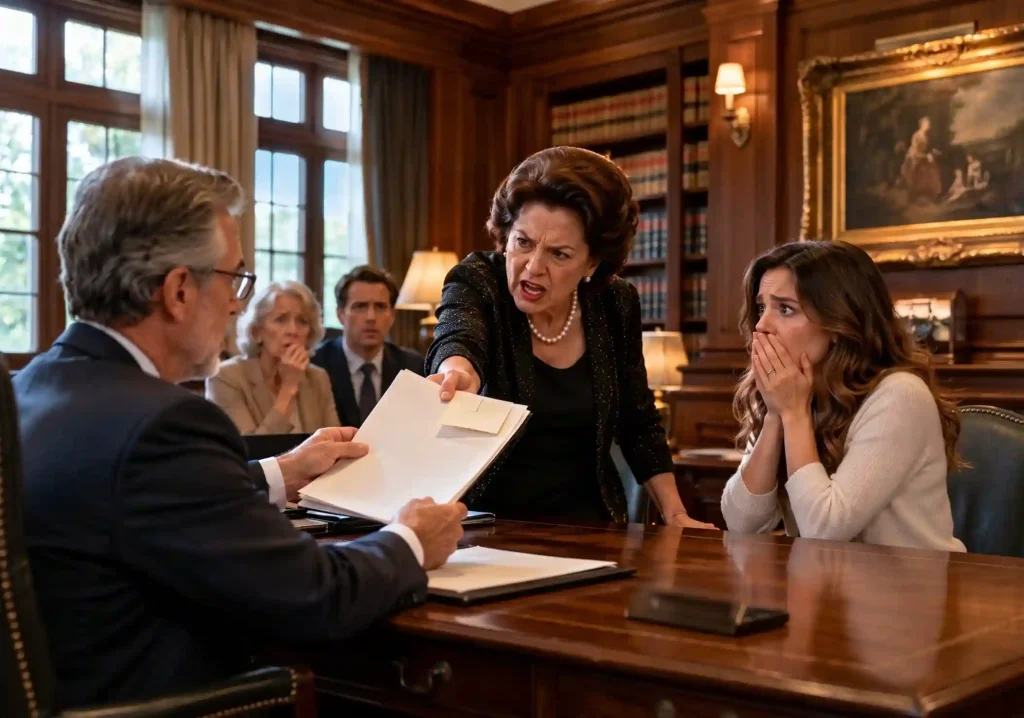
The moment the lawyer finished reading that section, my aunt jumped out of her chair.
“You’re a thief!” she shouted, pointing directly at me.
Everyone turned toward her.
She insisted that I must have manipulated my grandmother somehow. According to her, there was no reasonable explanation for why Grandma would leave everything to me instead of dividing the inheritance among the family.
“I deserve some of that money!” she demanded. “You can’t possibly expect us to believe this is what she really wanted!”
I sat frozen, struggling to understand what was happening.
I had never asked my grandmother for money. I had never demanded her house or savings. I had simply loved her and spent time with her whenever I could.
Yet, in that office, my aunt treated me as if I had committed a terrible crime.
The Lawyer Tried to Calm Everyone Down
The lawyer raised his hand and asked everyone to remain calm.
He explained that the will had been prepared and signed according to the proper legal process. My grandmother had made her wishes clear, and the document reflected those wishes.
But my aunt refused to accept his explanation.
She stepped toward the desk and tried to grab the will from his hands, desperately searching for something that might give her an opportunity to challenge it.
“There has to be something wrong with this!” she insisted.
The lawyer carefully moved the document away from her.
“Please sit down,” he said firmly. “There is something else we need to examine.”
Those words made everyone stop talking.
A Folded Note Hidden in the Final Page
As the lawyer reviewed the final page, he noticed a small folded note attached near the staple.
It appeared to have been placed there deliberately.
He gently removed it and unfolded the paper.
My aunt immediately leaned forward, her expression changing from anger to curiosity.
“What is that?” she demanded.
The lawyer studied the handwriting for a moment.
“This appears to be a personal note from your grandmother,” he explained.
He began reading aloud.
The first word was simple.
“I…”
Then he stopped.
The room fell silent.
Whatever my grandmother had written, it was clearly meant to be read alongside her final wishes.
Everyone Wanted to Know What Grandma Had Written
My aunt reached toward the note, but the lawyer held it carefully.
“Let me finish reading it first,” he said.
I could hear my own heartbeat. My grandmother had always been thoughtful, but she rarely discussed family disagreements openly.
If she had left a personal message, I knew it must have mattered to her.
My aunt crossed her arms impatiently.
“Whatever that note says, it doesn’t change the fact that I am her daughter,” she argued.
The lawyer looked up from the paper.
“Your relationship with your mother is not in question,” he replied. “But her wishes deserve to be understood.”
For the first time that afternoon, my aunt said nothing.
The Note Changed the Meaning of the Will
The lawyer explained that personal notes can provide context about a person’s intentions, although a note does not automatically override a legally valid will.
He continued examining the handwriting and the documents before him.
I began thinking about the final months of my grandmother’s life.
I remembered visiting her when she was lonely, helping her with small tasks, and sitting beside her while she told stories about our family. Those moments had never felt like obligations. They were simply time spent with someone I loved.
My aunt had her own memories with Grandma, too. But the anger in her voice that afternoon made it difficult to understand what she truly wanted: to honor her mother’s wishes or to receive a share of the inheritance.
The folded note seemed to hold an explanation that none of us had expected.
What My Grandmother Wanted Us to Understand
As the lawyer continued reviewing the documents, one thing became clear: my grandmother had wanted her decisions to be taken seriously.
The inheritance was not merely a collection of money and property. It represented years of hard work, careful choices, and the life she had built.
I wished my grandmother could have been there to explain everything herself.
Instead, we were left trying to understand her intentions through the words she had left behind.
My aunt had entered the office convinced that she had been cheated. I had entered believing we were simply there to hear Grandma’s final wishes.
Neither of us had expected a small folded note to become the center of the entire meeting.
And as the lawyer prepared to read the remaining words, I realized that the biggest question was no longer who would receive the money.
It was why my grandmother had chosen to leave everything the way she did.
The Real Lesson Behind the Inheritance
Family disagreements over money can reveal emotions that have been hidden for years.
Sometimes, people see an inheritance as proof of how much a loved one valued them. When they receive less than they expected, they may feel rejected or forgotten.
But money cannot measure the full meaning of a relationship.
My grandmother’s decision was hers to make, and understanding it required more than anger, accusations, or assumptions.
The note reminded everyone in that room that there was still more to the story than the first page of a will could explain.
Sometimes, the smallest message left behind can raise the biggest questions about family, trust, and what truly matters.
Conclusion
My grandmother’s will reading began as a formal meeting and quickly turned into a family confrontation. My aunt accused me of stealing, the lawyer struggled to maintain order, and a folded note hidden in the final page introduced an unexpected mystery.
The note’s opening word—”I…”—left everyone waiting for the rest of the message.
In the end, the story raises an important question: when a loved one leaves behind an unexpected inheritance, should family members immediately assume the worst, or should they first try to understand the person’s wishes?
FAQ
Why did the aunt call her niece a thief?
The aunt was angry because the grandmother reportedly left her entire estate to the niece. She believed the inheritance was unfair and accused the niece of wrongdoing.
What was hidden in the grandmother’s will?
A small folded note was attached near the staple on the final page. The note began with the word “I…” and introduced a mystery about the grandmother’s intentions.
Can a personal note change a will?
That depends on the applicable law and the circumstances. A personal note may provide context, but it does not automatically change or override a valid will.
Is this a verified true story?
The supplied Pinterest pin does not provide enough information to verify the events or reveal the note’s complete contents. This article develops the premise as a suspenseful family story rather than presenting an unverified ending as fact.