
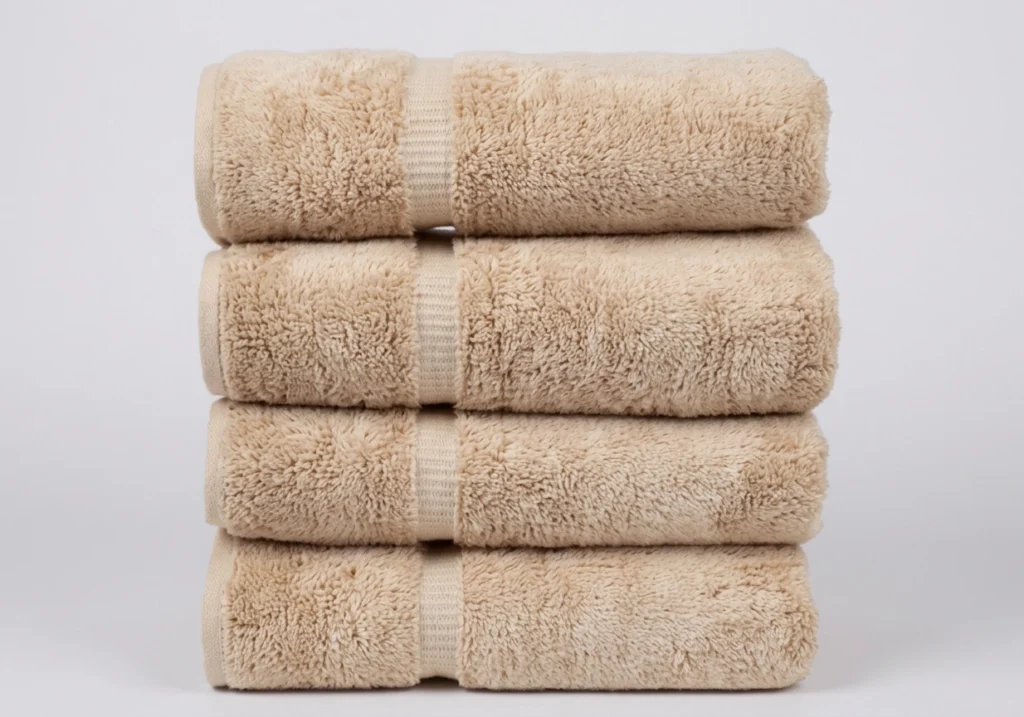

If you have ever folded a stack of bath towels, you have probably noticed the flat, woven lines near the ends. They look so ordinary that most of us never stop to wonder why they are there.
But that strip isn’t simply a random design choice. The section highlighted in the viral pin is called a dobby border, and it is woven differently from the soft, looped part of the towel.
1. That “Line” Is Actually a Dobby Border
The smooth strip near the end of a bath towel is known as a dobby border or, in some cases, a cam border. Unlike the fluffy terry portion of the towel, this area has a flatter and tighter weave.
It can come in different patterns, widths, and designs depending on the manufacturer. So while it certainly makes the towel look more finished, there is also a practical reason manufacturers put it there.
2. It Helps Strengthen the Towel
One important job of the border is to give the towel additional structure.
Bath towels are washed, spun, dried, folded, pulled, and handled repeatedly. The ends and edges can experience considerable wear, and the tighter woven section helps reinforce that area.
This can help reduce fraying and keep the towel from becoming misshapen as quickly with regular use and washing.
3. It Helps the Towel Keep Its Shape
The main body of a bath towel is made from loops that give it that soft, absorbent texture. The dobby border, by contrast, is more tightly woven and provides a more stable section near the edge.
That extra structure helps the towel maintain a neater shape instead of allowing the edges to stretch or curl as easily over time. It is one reason this seemingly simple strip can be useful beyond its appearance.
4. Why Is That Part Less Absorbent?
There is a reason the line feels different when you touch it.
The main terry portion has raised loops that can hold water, while the tightly woven border has fewer or no comparable loops. That means the border itself isn’t the part of the towel designed to do most of the drying.
So if you have ever wondered why that strip feels flatter and less fluffy, that’s intentional. The towel’s absorbent work is primarily done by the terry fabric surrounding it.
5. The Lines Don’t Have a Universal Secret Code
You may occasionally hear claims that one stripe or two stripes tells you exactly what size a towel is, or that the lines have a standardized meaning across all manufacturers.
That’s not something you should assume.
Some hotels or commercial operations may use particular designs, colors, or patterns to help distinguish products, but there is no universal rule that every towel manufacturer follows. The exact appearance of the border is largely determined by how that particular towel is designed and manufactured.
In other words, the line in your bathroom isn’t necessarily a secret code telling you something about the towel.
6. Why Do Manufacturers Put Them Near the Ends?
The location makes practical sense.
The border is normally woven close to the towel’s ends, where it can provide structure while leaving the large central area covered with absorbent terry loops.
It also gives manufacturers a convenient place to add patterns or branding without covering the main drying surface with embroidery or decoration.
7. So, What Do Those Lines Actually Mean?
The next time you see those flat lines on a bath towel, you can recognize them for what they are: a woven border built into the towel’s construction.
They can add a decorative finish, but their more practical role is to provide structure and reinforce the fabric near the ends. They are not a defect, they aren’t simply a random sewing mark, and they aren’t there because the towel is supposed to be folded at that exact line.
That tiny detail you have probably ignored for years is actually part of how the towel is constructed.