
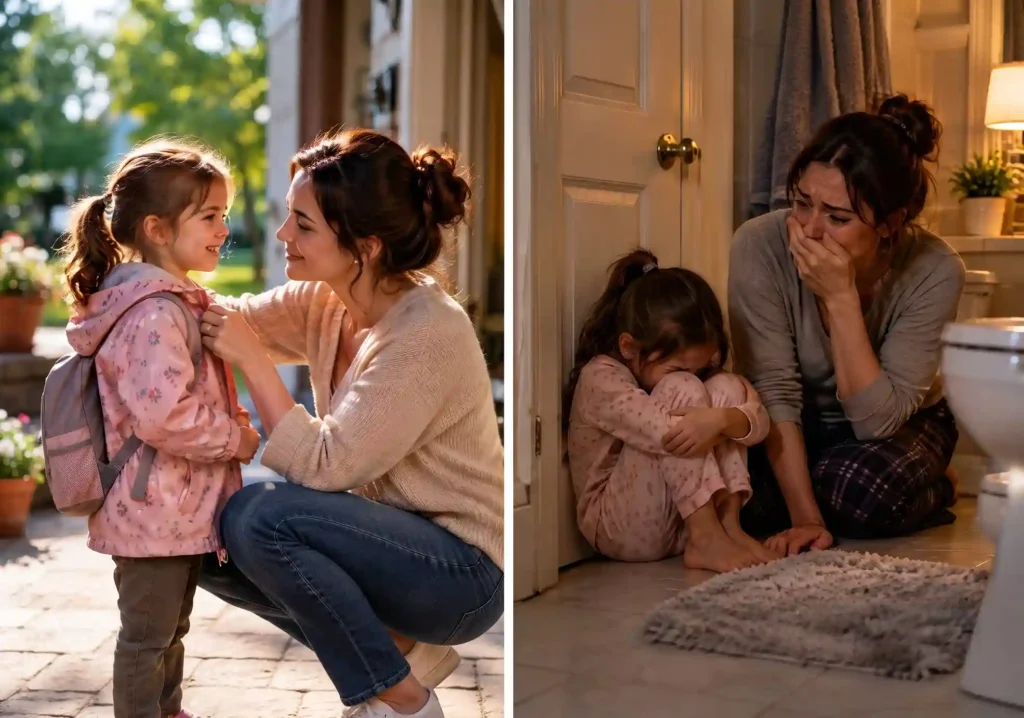

When I was little, my mom had a simple routine that I looked forward to every day. She would take me for a walk, hold my hand, and listen to me talk about all the little things that mattered in my world. But when we returned home, she would disappear into the bathroom and cry. Whenever I knocked on the door, she always gave me the same answer: “Mommy’s fine.”
I believed her because, as a child, I had no reason not to. It took losing her and growing older to understand that sometimes the people who make us feel safest are quietly carrying burdens we cannot see.
The Walks That Made My Childhood Special
When I think about my childhood, I don’t remember every toy I owned or every birthday present I received. What I remember most clearly are the walks I took with my mother.
Sometimes we walked around the neighborhood. Other times, we followed a path beneath tall trees, stopping to look at flowers or watch birds sitting on fences. My mom never seemed to be in a hurry during those moments.
She would ask me questions about my day, listen to my stories, and smile at things that probably weren’t nearly as funny as I thought they were.
To me, she seemed happy. She was my mother, my comfort, and the person who made ordinary days feel special.
I had no idea that those walks might have meant something entirely different to her.
The Bathroom Door I Never Understood
Almost every time we returned home, my mother found a reason to go into the bathroom.
Sometimes she said she needed a moment. Other times, she simply walked away without explaining anything.
After a while, I began noticing the sounds.
There were quiet sniffles, the occasional deep breath, and moments when the room went completely silent. I was young, but I knew what crying sounded like.
I would walk to the door and knock.
“Mommy? Are you okay?”
Her answer was always gentle.
“Mommy’s fine, sweetheart.”
Then she would ask me to go play, promising she would be out soon.
I trusted her words. I never imagined that a person could say they were fine while feeling completely broken inside.
I Thought My Mom Was Always Strong
Children often believe their parents have everything figured out.
We assume they know what to do when something goes wrong. We think they can fix any problem, answer every question, and protect us from anything that might hurt us.
My mother was that person to me.
She made sure I felt loved. She listened when I was upset and comforted me when I was afraid. Even on difficult days, she tried to make our little world feel safe.
Because she rarely showed me her sadness, I assumed she didn’t have much of it.
Now I understand that I was seeing only the part of her life she wanted me to see.
She was not free from fear or disappointment. She was simply trying to make sure I didn’t have to carry those feelings alongside her.
The Choice She Never Explained to Me
As an adult, I began looking back at those memories differently.
Why did my mother cry after our walks? Why did she wait until we were home to let her emotions show? And why did she always insist that everything was fine?
I cannot know every thought that passed through her mind. But I can imagine how difficult it must have been to face personal struggles while trying to give a child a happy childhood.
Perhaps she was weighing difficult choices about her future, our family’s circumstances, or the kind of life she wanted me to have.
Sometimes adults face decisions where neither option feels easy. They may have to choose between their own needs and someone else’s happiness, between the familiar and the uncertain, or between what they wish life could be and what they can manage at that moment.
Whatever my mother was facing, I wish she had known she didn’t have to be perfect to be loved.
She didn’t need to hide every tear from me to be a good mother.
Why She Tried So Hard to Hide Her Tears
Parents often protect children from problems they believe are too complicated or painful for them to understand.
A mother might be worried about money, struggling with a relationship, feeling lonely, or trying to make a major life decision. Yet when her child asks whether she is okay, she may smile and say yes.
It doesn’t necessarily mean she wants to deceive her child.
Sometimes she simply wants to preserve a little innocence for as long as possible.
My mother may have believed that keeping her pain private was one way to protect me. If I didn’t know how much she was struggling, perhaps I could enjoy my childhood without worrying about the things she couldn’t control.
I wish I could go back and tell her that she was allowed to have difficult days, too.
She was allowed to cry.
She was allowed to need help.
And she was allowed to be a person with feelings beyond the role of being my mother.
Three Years Without Her
My mother died three years ago.
Losing her changed the way I remember almost everything about our time together. The little things I once took for granted have become some of the most precious memories I own.
I miss her voice. I miss the way she listened to my stories. I miss the ordinary moments that never seemed important enough to remember when she was still here.
And I keep thinking about those walks.
Back then, I thought they were simply something my mother did because she loved spending time with me. Today, I recognize how much love can be hidden inside an ordinary routine.
She showed up for me even when she may have been struggling herself.
She gave me her time, her attention, and the comfort of feeling that I mattered.
I cannot change the difficult moments she experienced, and I cannot ask her the questions I wish I had asked. All I can do is appreciate what she gave me and acknowledge the parts of her life I was too young to understand.
What I Wish I Had Said at That Bathroom Door
If I could return to one of those afternoons, I wouldn’t demand that my mother explain why she was crying.
I would sit outside the door and tell her something simple.
“Mom, you don’t have to pretend with me.”
I would tell her that I loved her even when she was sad. I would remind her that she didn’t need to smile every moment to make me happy.
I would let her know that the mother who comforted me deserved comfort, too.
Of course, a young child cannot be expected to understand or solve an adult’s problems. That responsibility should never have belonged to me.
But now, as an adult, I wish someone had been there to remind her that she deserved support and kindness just as much as anyone else.
I hope she had moments when she felt understood, even if I was too young to recognize them.
The Lesson I Carry With Me
Growing up has a way of changing our understanding of the people we love.
When we’re children, we see our parents mainly through what they do for us. As adults, we begin to realize that they had entire lives beyond our childhood memories.
They had dreams, regrets, worries, and decisions they rarely discussed with us.
They were learning as they went, just as we are.
Remembering my mother’s tears reminds me not to assume that someone is doing well simply because they keep smiling. It reminds me to ask people how they are feeling and give them space to answer honestly.
It also reminds me that love doesn’t mean being happy all the time. Sometimes love means continuing to show up for someone while quietly hoping that tomorrow will be easier.
I may never know everything my mother was carrying during those walks. But I know she made me feel loved, and that is something I will carry for the rest of my life.
One Thing I Would Tell Every Child
If your parent ever struggles, remember that their sadness is not your fault.
You do not have to fix their problems, make every decision easier, or become responsible for their happiness. You are allowed to be a child, and adults deserve support from other adults who can help them through difficult times.
And if you are a parent who has cried behind a closed door, remember that you deserve care, too.
You don’t have to be endlessly strong to be a loving parent.
Sometimes asking for help is one of the most loving things you can do for yourself and your family.
Frequently Asked Questions
Why did the mother cry after taking her child for walks?
The pin does not provide a confirmed explanation. The story suggests that the mother was dealing with a private emotional struggle that her child was too young to understand.
Why did she tell her child that she was fine?
Parents sometimes hide their worries because they want their children to feel safe. However, the exact reason this mother cried is not established by the text in the pin.
Why do childhood memories feel different when we grow older?
As adults, we understand emotions, relationships, and responsibilities in ways we couldn’t as children. This can give old memories new meaning, even when we cannot know exactly what another person was experiencing.
How can someone support a parent who is struggling emotionally?
Listen without judgment, offer practical help when appropriate, and encourage them to seek support from trusted adults or a qualified professional. Children should never be made responsible for solving a parent’s emotional or personal problems.
Key Takeaway
Sometimes, we understand our parents’ sacrifices only after we grow up. The memories that once seemed ordinary can become reminders of how much we never knew about the people who loved us.
We may never discover every reason behind their tears, but we can learn to offer others the same patience, compassion, and understanding we wish they had received.
Conclusion
My mother has been gone for three years, but those childhood walks remain with me.
I remember her holding my hand, listening to my stories, and making me feel like I was the most important person in the world. I also remember the bathroom door, the quiet crying, and the familiar words, “Mommy’s fine.”
I was too young to understand what she might have been going through. Now, I wish I could give her the reassurance she gave me so many times.
I wish I could tell her that she didn’t have to hide every tear.
Most of all, I wish I could take one more walk with her—not to uncover every secret she carried, but simply to hold her hand and say what I hope she always knew:
“Mom, you were loved, even on the days when you weren’t fine.”