
Have you ever looked at your hand and wondered whether the length of your little finger says something about your personality? A popular palmistry trend suggests that the pinky finger’s position in relation to the ring finger can reveal clues about communication, confidence, and relationships.
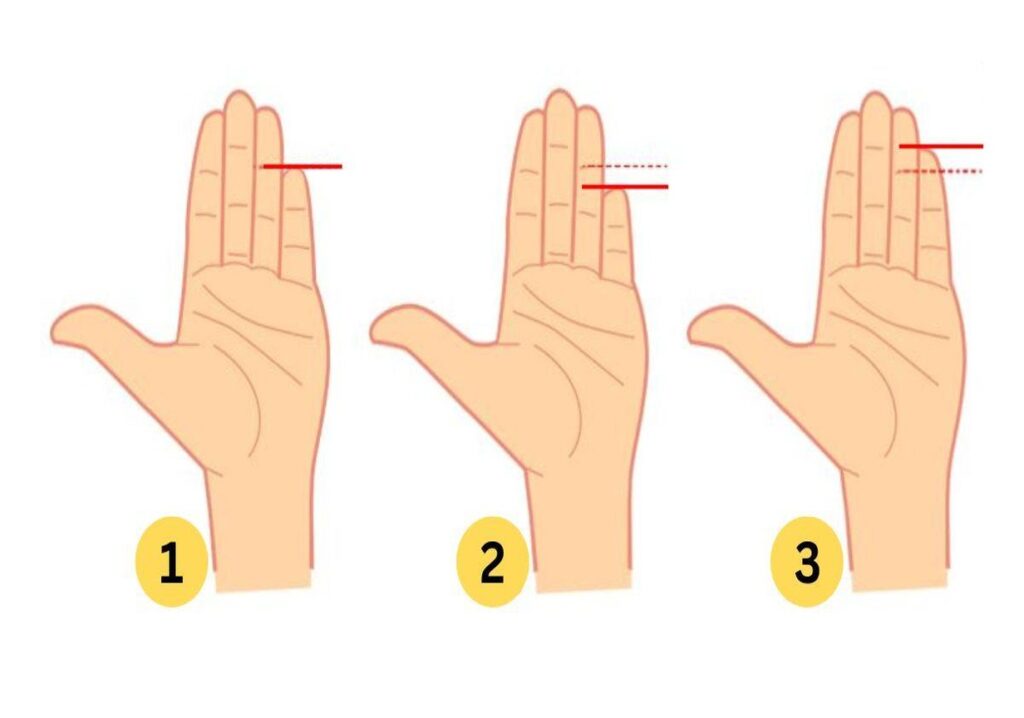
According to these traditional interpretations, people are often grouped into three types: those whose pinky appears lower, those whose pinky reaches about the same level, and those whose pinky appears higher.
But how much of this is actually true? Let’s explore all three types, what palmistry traditionally says about them, and what science can—and cannot—tell us about finger length.
1. A Pinky Finger That Appears Lower
In the pin’s illustration, the first type has a pinky that appears shorter or sits lower than the reference line on the ring finger.
What Palmistry Traditionally Says
Some popular palm-reading interpretations associate a shorter-looking pinky with a more reserved communication style. According to these beliefs, people in this category may prefer listening before speaking, take time to open up, or feel more comfortable sharing personal feelings with people they trust.
The same interpretations sometimes describe these individuals as thoughtful and cautious when forming relationships. They may prefer to observe a situation before deciding what to say or do.
However, these are traditional personality descriptions rather than scientifically established characteristics. A person with a shorter pinky may be outgoing, confident, expressive, or naturally quiet—just like anyone else.
What It Could Mean in Real Life
If you tend to be reserved, your communication style is more meaningfully understood through your experiences, preferences, and social environment than through your finger length.
Some people take time to trust others because of their upbringing or past experiences. Others simply prefer smaller social gatherings or more thoughtful conversations.
The takeaway: A lower-looking pinky can be an interesting feature to notice, but it cannot tell you whether someone is shy, private, or emotionally guarded.
2. A Pinky Finger That Appears Even
The second type shows a pinky that appears to line up with the reference point used in the illustration.
What Palmistry Traditionally Says
In popular palmistry content, this type is sometimes associated with balance in communication. People are described as being comfortable expressing themselves while also listening to others.
These interpretations may portray them as practical communicators who can share their thoughts without feeling the need to dominate every conversation.
Some versions also associate this finger position with an ability to find a middle ground during disagreements.
It is an appealing description, but there is no reliable scientific evidence that a pinky reaching a particular level predicts communication skills, emotional balance, or conflict-resolution ability.
What Communication Skills Actually Depend On
Good communication involves several learnable skills, including:
- Listening carefully before responding.
- Expressing feelings and needs clearly.
- Asking questions instead of making assumptions.
- Respecting differences of opinion.
- Recognizing when a conversation needs patience or empathy.
People can improve these skills through experience, reflection, and practice, regardless of their hand proportions.
The takeaway: If you identify with being a balanced communicator, celebrate that quality—but recognize that it comes from your behavior, not a particular pinky measurement.
3. A Pinky Finger That Appears Higher
In the third illustration, the pinky appears to reach higher than the reference line.
What Palmistry Traditionally Says
Some online palmistry interpretations associate a higher-looking pinky with confidence, expressiveness, or a willingness to speak openly.
According to these descriptions, people in this category may be comfortable sharing opinions, initiating conversations, or expressing what they want.
Other interpretations connect the same feature with independence or strong personal boundaries.
These descriptions can be entertaining to compare with your own personality, but they should not be treated as reliable assessments. A longer-looking pinky does not establish that someone is confident, persuasive, independent, or particularly skilled at relationships.
Confidence Is More Than Appearance
Confidence can vary depending on the situation. Someone may feel comfortable speaking in public but become nervous when discussing personal feelings. Another person may be quiet in a group yet communicate exceptionally well one-on-one.
Confidence also develops through practice, supportive relationships, and experience. It is not a fixed quality that can be measured by looking at one part of the hand.
The takeaway: Your confidence is better understood through how you approach challenges, communicate with others, and respond to unfamiliar situations than through your pinky finger.
Pro Tip: Compare Your Pinky Without Overthinking It
If you want to try the trend, hold your hand naturally with your palm facing you and compare the pinky with the reference point shown in the original illustration.
Remember that hand position, finger angle, and the exact crease used as a reference can change how the comparison looks. The pin is a simplified illustration, not a standardized scientific measurement.
You can use the exercise as a conversation starter or a fun way to reflect on your personality. Just avoid using it to judge a partner, friend, coworker, or potential romantic interest.
Important Note: Can Your Pinky Really Reveal Your Personality?
There is no established scientific method for determining someone’s personality from the relative length of their pinky finger.
Researchers have investigated whether certain finger-length ratios are associated with aspects of biology or behavior. However, findings about these measurements have limitations, and they do not provide a dependable way to predict an individual’s personality.
A report in the journal Science discussed substantial scientific skepticism surrounding claims that finger proportions can reliably reveal personality traits or other characteristics. Research examining finger lengths and the Big Five personality traits has also found associations that were weak and inconsistent.
Finger proportions are physical characteristics influenced by development and genetics. They are not a personality test, a measure of intelligence, or a dependable guide to someone’s romantic behavior.
Myth vs. Fact
| Myth | Fact |
|---|---|
| A short pinky means someone is shy. | Finger length cannot reliably establish whether a person is shy or outgoing. |
| An even pinky means someone communicates well. | Communication skills are shaped by behavior, experience, and practice. |
| A longer pinky proves someone is confident. | Confidence varies by person and situation; finger length is not a reliable measure of it. |
| Pinky length reveals how someone behaves in relationships. | Relationship behavior cannot be accurately predicted from this physical feature. |
| Everyone fits neatly into one of these three types. | The illustration simplifies natural variation in hand proportions. |
| Palmistry descriptions are scientific personality assessments. | Palmistry is a traditional interpretive practice, not a validated way to measure personality. |
Quick Checklist: What Does Your Pinky Look Like?
Use the original pin as a fun visual comparison:
- Lower: My pinky appears to sit below the illustrated reference point.
- Even: My pinky appears to line up with the reference point.
- Higher: My pinky appears to reach above the reference point.
- Unsure: My finger position does not clearly match any of the three examples.
Once you have picked a type, compare its traditional palmistry description with your own experiences if you like. Treat any similarities as personal reflection rather than proof that the interpretation is correct.
Frequently Asked Questions
What does a short pinky finger mean?
In some palmistry interpretations, a shorter-looking pinky is associated with reserved communication or taking time to open up. These are traditional beliefs, not scientifically proven conclusions about personality.
What does it mean if my pinky is the same height as my ring finger’s crease?
In the context of this pin, it represents the even category. Palmistry may associate it with balanced communication, but the finger’s position does not establish how well someone communicates.
Does a long pinky mean a person is confident?
No. A longer-looking pinky does not reliably indicate confidence, independence, or social ability. Those qualities are better understood through a person’s actual behavior.
Is pinky length genetic?
Hand and finger proportions are influenced by biological development and genetics, along with normal variation between individuals. A particular pinky length does not, by itself, reveal a person’s character.
Can palmistry accurately predict personality?
Palmistry offers traditional interpretations of hand features, but it is not a scientifically validated personality assessment. If you want to understand your personality, validated psychological assessments and reflection on your real-life behavior are more useful approaches.
Conclusion
The pinky-finger trend divides hands into three categories: lower, even, and higher. Traditional palmistry attaches different personality descriptions to each type, ranging from reserved communication to balance and confidence.
Those descriptions can make an interesting conversation topic, but they should not be mistaken for scientific facts. Finger length cannot reliably tell you how someone thinks, communicates, handles relationships, or feels about themselves.
The most meaningful clues about a person’s character come from how they treat others, respond to challenges, and communicate in everyday life—not from the proportions of their hand.
Key Takeaway
Your pinky finger may be unique, but it cannot reliably reveal your personality. Enjoy the trend as a fun curiosity, and let your actions and experiences—not the shape of your hand—tell your story.