
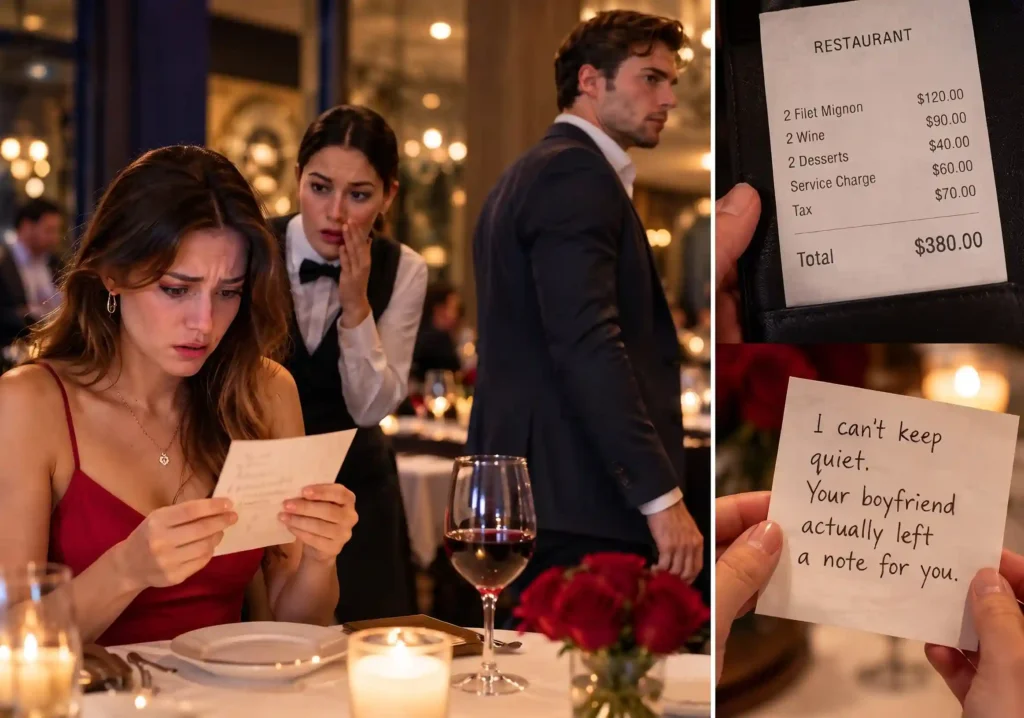

He Insisted on a Luxury Valentine’s Dinner
I had imagined Valentine’s Day being romantic, but I never expected it to turn into one of the most uncomfortable evenings of my relationship.
My boyfriend insisted that we celebrate at an expensive restaurant. He chose the place, talked about how special the evening would be, and made it sound like he had planned something unforgettable.
I was happy to go along with it. I didn’t need an expensive dinner to feel loved, but I appreciated the thought of spending the evening together.
The restaurant was beautiful. There were candles on the tables, soft music playing in the background, and couples enjoying their Valentine’s celebrations. Everything looked perfect.
At first, I thought the night was going exactly as he had planned.
Then the bill arrived.
The $380 Check Changed the Mood
When the waitress placed the check on our table, I glanced at the total.
It was $380.
Before I could even process the amount, my boyfriend looked at me and said that I needed to pay half.
I was genuinely surprised.
He had insisted on choosing the expensive restaurant. He had made the reservation and encouraged us to order there. I hadn’t demanded a luxury dinner or suggested spending that much money.
I told him I wasn’t comfortable paying half of such an expensive bill.
I wasn’t refusing to contribute to a date. I simply didn’t think it was fair to make an expensive plan and then surprise the other person with an unexpected payment.
He didn’t seem interested in discussing it.
The romantic atmosphere suddenly felt very different.
He Paid the Entire Bill Without Saying a Word
I refused to pay half.
For a moment, neither of us said anything. I could tell he was upset, but I didn’t want to agree to something just to avoid an uncomfortable conversation.
He eventually took out his card and paid the entire bill.
He didn’t argue, raise his voice, or try to convince me again.
Instead, he stood up, collected his things, and walked out of the restaurant.
I sat there feeling embarrassed and confused.
Other couples were still enjoying their meals, and the restaurant staff continued working as if nothing had happened. I wanted to leave immediately, but I also needed a moment to understand what had just happened.
Was he angry because I refused to pay?
Had I misunderstood what he expected from the evening?
Or had the dinner revealed a disagreement about money that we had never properly discussed?
I had no answers.
The Waitress Came Back With Something Unexpected
Just when I thought the evening couldn’t become any more uncomfortable, the waitress approached my table.
She looked at me with a gentle expression and lowered her voice.
Then she said something I wasn’t expecting.
“I can’t keep quiet. Your boyfriend actually left a note for you.”
My heart dropped.
I looked at her, unsure whether I had heard correctly.
She handed me a small folded piece of paper.
For a few seconds, I simply stared at it. My boyfriend had already walked out, yet somehow he had left something behind for me.
I carefully unfolded the note.
What the Note Made Me Realize
The note wasn’t a long explanation or an angry message.
In this fictionalized continuation, it reads:
“I’m sorry tonight became uncomfortable. I wanted to make this evening special, but I handled the conversation about money badly. I should never have made you feel pressured to pay for something you didn’t agree to. I paid the bill because I invited you here. I don’t want an expensive dinner to become a reason for us to hurt each other. We need to talk honestly about what happened, but please don’t think your feelings don’t matter to me.”
I read it twice.
It didn’t magically erase the awkward evening, and it didn’t mean that everything was suddenly fine. But it gave me a different perspective on what had happened.
The problem was never simply the $380.
It was the expectation that had been placed on me without a proper conversation. It was the way the evening changed when I disagreed. And it was the realization that even couples who care about each other can have very different expectations about money.
I folded the note and placed it in my purse.
I knew we still needed to talk.
The Real Issue Was Bigger Than the Dinner Bill
Money can be a sensitive subject in relationships, especially when two people have different financial situations or expectations.
Some couples prefer to split every expense equally. Others take turns paying, or agree that whoever invites the other person will cover the cost.
There isn’t one arrangement that works for everyone.
What matters is that both people understand and agree to it.
If someone plans an expensive evening, it is reasonable to discuss the budget beforehand. Nobody should have to discover the financial expectation only when the bill arrives.
A romantic gesture should never become an unexpected financial obligation.
And paying for dinner doesn’t give someone the right to control how the other person feels or responds.
Why Honest Conversations About Money Matter
Many relationship disagreements begin with assumptions.
One person believes splitting the bill is perfectly fair. The other believes the person who planned the expensive date should have discussed the cost first.
Neither person can know what the other expects without communicating.
A healthy conversation about money doesn’t need to be uncomfortable. Couples can discuss budgets, preferences, and financial boundaries before making plans.
It’s also important to remember that fairness doesn’t always mean dividing every expense down the middle. Fairness means finding an arrangement that both people genuinely accept.
The goal should be understanding, not winning an argument.
What I Would Do Differently Next Time
Looking back, I would have preferred to discuss the restaurant and budget before Valentine’s Day.
If I knew the dinner would cost $380, I could have explained what I was comfortable spending. We could have chosen a different restaurant or agreed on the payment arrangement beforehand.
I also would have wanted us to talk about the disagreement instead of allowing the evening to end with one person walking away.
A relationship needs room for disagreement. Saying no to an expense should not automatically become a judgment about how much someone cares.
And a thoughtful note, while meaningful, cannot replace an honest conversation.
Conclusion
What started as a romantic Valentine’s dinner became an unexpected lesson about communication, money, and boundaries.
The $380 bill wasn’t the only thing that mattered that evening. What mattered was how two people handled an uncomfortable disagreement and whether they were willing to understand each other’s perspective afterward.
A special date shouldn’t leave someone feeling pressured, embarrassed, or financially trapped.
Love isn’t measured by the price of a restaurant, the size of a bill, or who reaches for a credit card first.
Sometimes, the most important thing a couple can do is talk honestly before a small disagreement becomes a much bigger problem.
FAQ
1. Is it fair to split a $380 Valentine’s dinner bill?
It can be fair if both people agreed to the arrangement beforehand. The important part is discussing the cost and expectations before ordering.
2. Should the person who invites someone on a date pay?
Not necessarily. Couples have different preferences. However, if someone plans an expensive date, discussing who will pay is a considerate way to avoid surprises.
3. Is refusing to split an expensive restaurant bill wrong?
Not automatically. A person can set a financial boundary, especially when the expense was never discussed or agreed upon.
4. How should couples handle disagreements about money?
They should talk calmly, explain their expectations, and agree on a payment arrangement that feels fair to both people.
5. Can money disagreements affect a relationship?
Yes. Repeated disagreements about spending, expectations, and financial boundaries can create resentment if couples avoid discussing them.
Key Takeaway
A romantic evening should bring two people closer, not leave one feeling pressured by an unexpected bill. Clear communication about money is just as important as thoughtful gestures.